One of Tunisia’s most underrated attractions is not its hidden desert oases or historic ruins, but its natural beauty. Few travelers realize that this small North African nation possesses a varied network of hiking trails, from cork oak forest paths in the north to a fortress-topped mesa once used by a Numidian king.
At Xperience Tunisia, we believe exploring on foot is one of the most immersive ways to understand a country, which is why we include both walking tours and hikes as part of our Multi-Day Tours of Tunisia. In this guide, we take a closer look at the hiking trails in Tunisia worth exploring, along with their length, difficulty, and the terrain you can expect.

Djebel Zaghouan: An Iconic Ascent
Djebel Zaghouan is Tunisia’s most storied hiking route. Located approximately a 70-kilometer drive south of Tunis in a national park, Djebel Zaghouan is the highest point in Eastern Tunisia, rising to 1,295 meters. The trail begins at the Temple of Water, the remarkably preserved Roman nymphaeum that once marked the source of the aqueduct supplying Carthage. It climbs through rocky, forested terrain past the ruin of Kef el Blidah and the Sidi Bougabrine shrine before gradually reaching the summit.
The full route runs roughly 10 kilometers one way or 20 kilometers as a round trip, with an elevation gain of around 975 meters, typically taking between 3.5 and 4.5 hours each direction. The terrain is rocky underfoot, with some sections of loose scree and a stretch where it’s easy to lose the trail. This a moderate to challenging hike best suited to those with some prior experience and a reasonable level of fitness.
To learn more about the Temple of Water, and other lesser-known but worthwhile destinations, read our guide to the best Hidden Gems in Tunisia.

Jugurtha’s Table: A Fortress on a Mesa
Near the town of Kalaat es Senan, Jugurtha’s Table is one of Tunisia’s most striking geological formations: a flat-topped limestone mesa rising some 600 metres above the surrounding plain to an elevation of 1,271 metres. The mountain takes its name from the Numidian king Jugurtha, who used its natural defences to hold off Roman legions in the second century BC.
From the trailhead near the village of Ain Senan, the approach takes roughly two hours on foot to the base of the cliffs, however, you can also drive directly to the base. From here, you’ll climb a flight of 136 rock-cut steps up to the plateau itself. Once on top, the summit opens into an 80-hectare tableland scattered with ancient ruins, cisterns, and a 360-degree view that stretches into eastern Algeria. The climb is short but steep, making it a moderate hike best tackled outside the height of summer, when the exposed final ascent is far more comfortable.
For more details on Tunisia’s seasonal weather, read our Insider Travel Tips for Visiting Tunisia.
The Kroumirie Mountain Forests: A Natural Respite
In Tunisia’s far northwest, the Kroumirie Mountains hold a landscape of cork oak forest, mist-filled valleys, and considerably cooler temperatures than the rest of the country. Ain Draham, roughly 30 kilometres inland from Tabarka, is the natural base for exploring on foot, with well-marked forest paths and the option to hire a local guide for deeper access into the woodland.
The walking here is gentler than at Zaghouan or Jugurtha’s Table, with well-shaded, easy-to-moderate trails that make the region a good entry point for travelers seeking more relaxed walks, some birdwatching, or enjoying a picnic beneath the trees.
The Dahar Massif: A Multi-Day Berber Village Trail
In the far south, the Dahar Massif is home to the Great Dahar Crossing, Tunisia’s first long-distance hiking trail at roughly 194 kilometres split across 12 stages. The full route begins in the Amazigh village of Tamezret and threads its way through a string of other hilltop villages, archaeological sites, and natural scenery before concluding at the cliffside village of Douiret.
Very few travelers walk the entire crossing, which is really designed as a thru-hike for committed long-distance walkers. Most tackle the Dahar instead through a selection of its stages, strung together into a shorter, curated multi-day route. A popular selection links Tamezret, Matmata, and Beni Zelten over roughly 33 kilometres and two days, while the closing stage between Douiret and Chenini, two of the region’s best-preserved hilltop villages, makes for a shorter and more accessible standalone day hike.

Xperience Tunisia’s Signature Trekking Tour
For travelers who want their hiking woven into a wider journey through Tunisia’s landscapes and history, our Hiking Xperience is a six-day private itinerary built around exactly that. Beginning and ending in Tunis, the route opens with a hike across the rugged trails of Zaghouan and the historic ruins of Zriba Olia, before continuing on to Kairouan.
From there, the journey heads to Tozeur, on the edge of the Sahara, where you’ll spend a day hiking through the breathtaking oases of Chebika, Tamerza, and Mides. The route then crosses the surreal salt flats of Chott El Jerid to Douz, where a five-hour camel trek carries you deep into the dunes for a night at a desert camp beneath the stars.
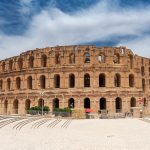
From the Sahara, the tour continues through the troglodyte village of Matmata and the palm groves of Gabes, on to the coastal city of Sousse. We finish with a visit to El Jem’s remarkable Roman amphitheatre and a final hike through the trails of Sidi Jedidi near Hammamet. As with all of our tours, the itinerary is entirely private and can be adjusted to suit you.
Given that this tour also spends time at the edge of the Sahara, a little preparation goes a long way, particularly around hydration, sun protection, and dressing for the shift between mountain and desert climates. We’ve written extensively on this in our guide, Essential Tips When Preparing for Tunisia’s Sahara Desert, which is well worth a read before setting out.

Discover Tunisia’s Trails with Xperience Tunisia
Whether your idea of a hike involves a technical summit push, a forest trail, or several days spent crossing the Sahara, Tunisia has a route to match. At Xperience Tunisia, we design entirely private, tailor-made journeys that pair the country’s finest trails with expert local guiding, comfortable accommodation, and a pace that suits you. If you’d rather chart your own course entirely, our Custom Tunisia Tours builder allows you to design an itinerary around the trails that call to you.
Ready to lace up your boots and discover Tunisia on foot? Get in touch with our team, and let us help you plan an unforgettable hiking journey.